

The NIST Cybersecurity Framework (CSF) 2.0, released in February 2024 (exactly one year ago today), introduced several significant updates compared to CSF 1.1 (2018) to address evolving cybersecurity challenges and broaden its applicability.
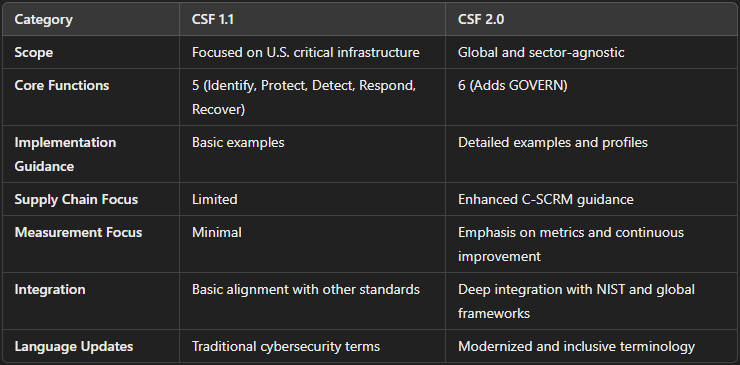
Below I have list of the major differences between CSF 1.1 and CSF 2.0:
- Expanded Scope Beyond Critical Infrastructure
- CSF 1.1: Primarily aimed at U.S. critical infrastructure sectors.
- CSF 2.0: Broadened to be globally applicable across all sectors and organization sizes, including small businesses, non-profits, and educational institutions.
Why it matters: More inclusive for organizations beyond critical infrastructure.
- Introduction of a New Function: GOVERN
- CSF 1.1: Had five core functions: Identify, Protect, Detect, Respond, Recover.
- CSF 2.0: Added a sixth core function: Govern.
Govern Function Focus:
- Establishing and communicating cybersecurity strategy, policies, and roles.
- Addressing risk management, legal/regulatory requirements, and governance structures.
Why it matters: Elevates the importance of leadership and decision-making in cybersecurity.
- Enhanced Implementation Guidance
- CSF 1.1: Provided general guidance without detailed implementation examples.
- CSF 2.0: Introduced CSF Profiles 2.0 and expanded guidance with:
- Example implementation approaches
- Sector-specific profiles
- Improved measurement and assessment tools
Why it matters: Easier for organizations to implement and measure progress.
- Integration with Other NIST Resources
- CSF 1.1: Linked to other frameworks but lacked deep integration.
- CSF 2.0: Stronger alignment with:
- NIST Risk Management Framework (RMF)
- NIST Privacy Framework
- Other international standards (e.g., ISO 27001, COBIT)
Why it matters: Simplifies managing cybersecurity, privacy, and risk in tandem.
- Emphasis on Supply Chain Risk Management
- CSF 1.1: Mentioned supply chain risks but lacked depth.
- CSF 2.0:
- Strengthened focus on Cyber Supply Chain Risk Management (C-SCRM).
- Provides clearer controls and considerations for third-party risks.
Why it matters: Addresses growing concerns over supply chain cybersecurity vulnerabilities.
- Focus on Measurement and Continuous Improvement
- CSF 1.1: Encouraged improvement but lacked specific measurement tools.
- CSF 2.0:
- Provides metrics and measurement guidance.
- Helps organizations assess cybersecurity maturity and drive continuous improvement.
Why it matters: Supports data-driven cybersecurity decision-making.
- Updated Language and Terminology
- Modernized terminology to reflect evolving technology and threats.
- More inclusive language for global and diverse audiences.
Summary of Major Changes
I hope you found this post helpful and informative. Thanks for stopping by!



 CyberCasta
Leave a comment